
Drawing the line on AI writing, literally
A short visual follow-up to yesterday's post
I’ve enjoyed the response to my post on AI writing. The fairest push-back, I think, has been that we ought to be more precise in separating out different sorts of writing and AI assistance.

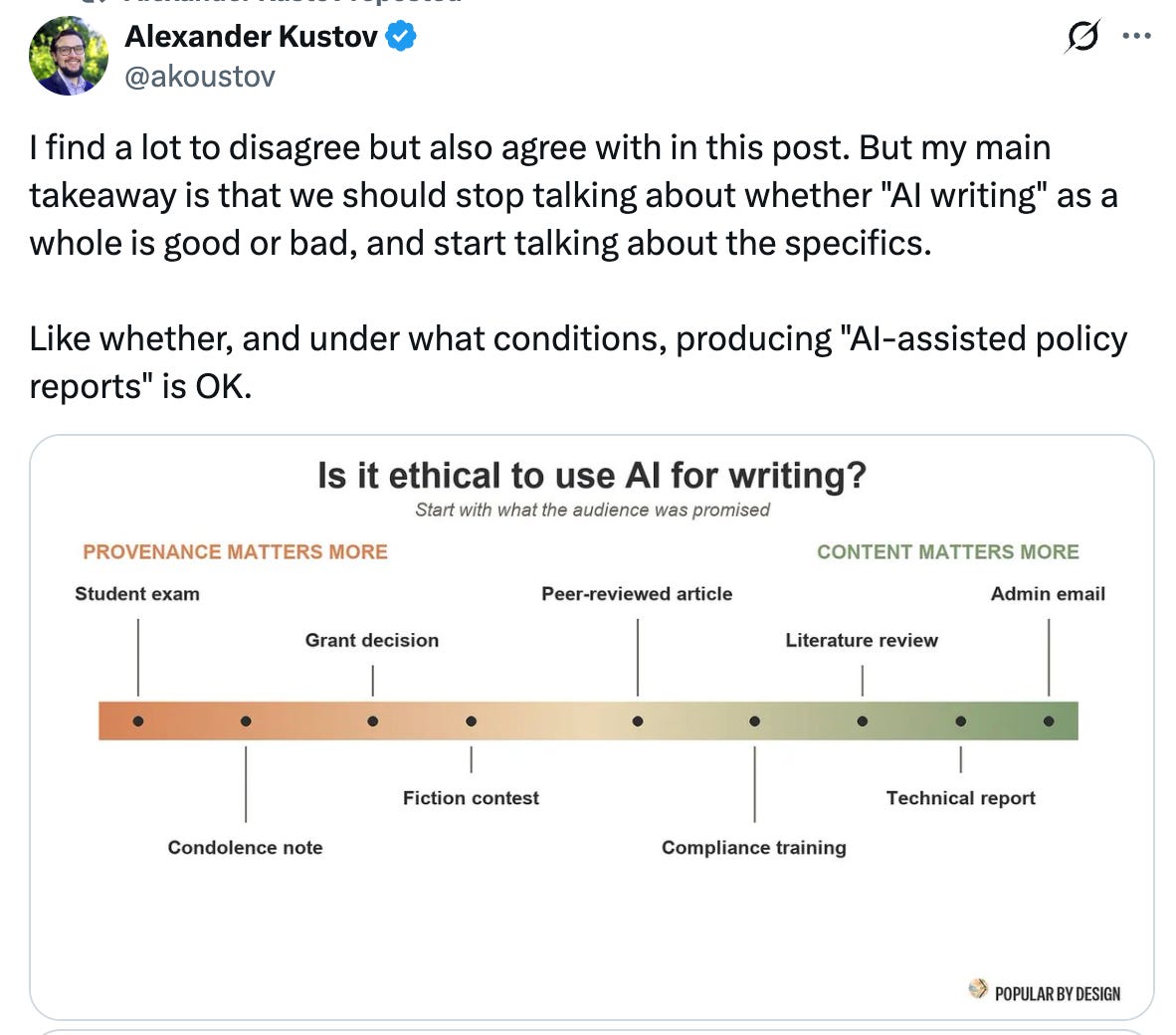
The academic Alexander Kustov, for instance, drew a spectrum of “provenance-first” to “content-first” writing, where AI is more acceptable in the latter case than the former. Quite often, I find the right response to nuance is just to draw a line. (On Kustov’s range, mine would sit between “Peer-reviewed article” and “Compliance training”.) But mainly, I’d focus on different axes.
If I had to pick the two dimensions that matter most, I’d bid for:
What role does AI play in the writing process?
How mechanical, versus ideas-led, does the final product need to be1?
So in that just-draw-a-line spirit, I sketched out my own two-by-two chart with examples for those ranges2. Top of my “AI involvement” category is simply publishing the one-shot output from a prompt; the bottom is using AI only to catch typos and poor syntax. The most mechanical writing format on my range is an administrative email; the most ideas-led is a novel.
Obviously two dimensions don’t capture everything. Exams might be fairly mechanical but still not somewhere we want AI, since the goal is assessment. Similarly, I feel a bit queasy about politicians using AI to explain themselves to voters, even if the actual text isn’t all that sophisticated.
But here’s my effort at drawing a line, or really colouring one in. I should add, too, that I focused on where our overall norms should sit—my own practice is a bit tighter: I don’t let AI touch my text whatsoever, but do use it on this blog as a research tool, for proofreading, and to help red-team weaker points in my arguments. (And I hope no-one is foolish enough to think that I in any way speak for my employer, but obviously The Economist has its own strict policies on AI, which you can see here.)
Take a look and see what you think. Even for an AI writing Luddite like myself, there is quite a lot of green!3
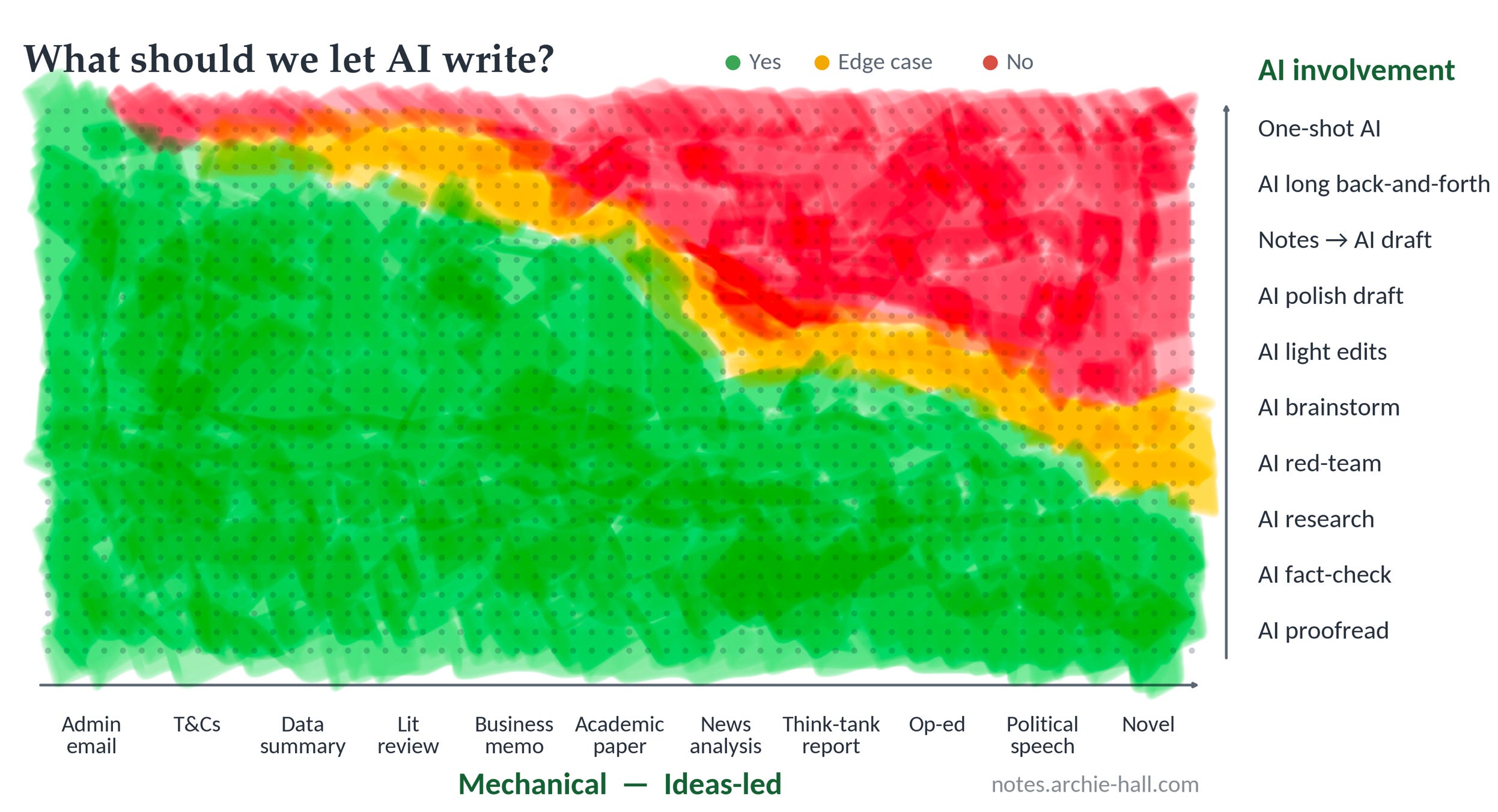
The red blotches reflect my view that AI shouldn’t intrude too far into the writing process when you’re trying to spread ideas or change minds—even if LLMs eventually become acceptable prose stylists. AI writing does a disservice to readers by making your thinking fuzzier and breaking the helpful link between clean prose and coherent ideas.
But not every sort of writing has those goals. If AI can do a good job writing a Terms and Conditions page, I see no reason not to give that win to the computers! Anyway, I found the exercise helpful in forcing me to pin down my own edge cases.
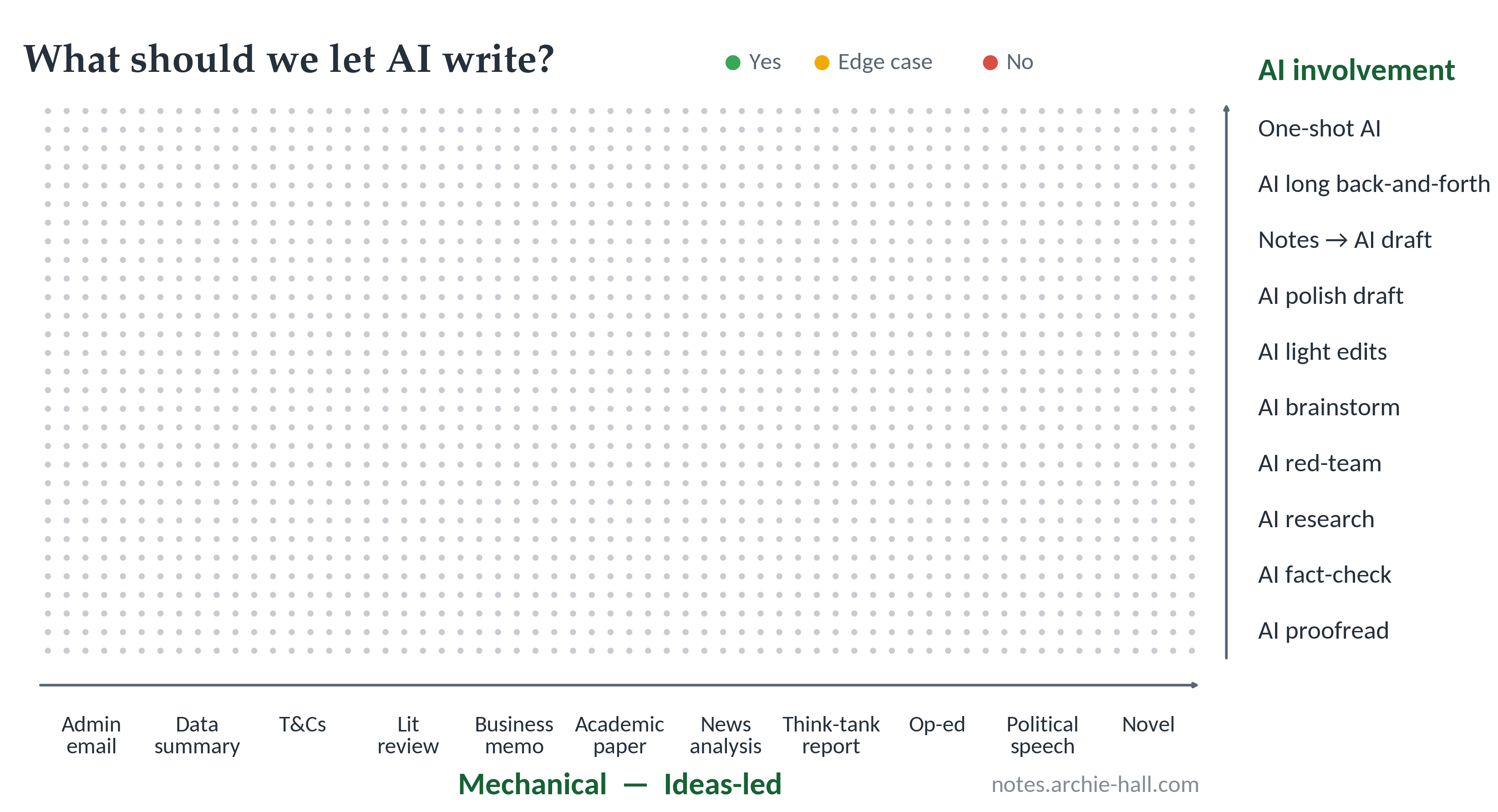
If anyone fancies getting out the crayons themselves, here’s a blank version of the same grid.
I’m looking for a nice single word that captures “mechanical versus ideas-led”. Neither I nor various LLMs ginned up any excellent suggestions, but perhaps readers will do better.
Or, more specifically, I had a long back-and-forth with Claude Cowork pleading with it to put the labels in the right places and get the dots to be a nice size.
One early reader described the chart as “mystifying”, but I’ve valiantly ignored that feedback.
I really like this and will be breaking out the crayons myself. One case that's genuinely flustered me recently: my 9-5 involves curriculum writing for English-language learners, and I've found AI to be extremely good at stripping out the idioms and passive voice that naturally slip into instructional content, despite the writer's best efforts. Most curriculum content fits more naturally on the "mechanical" side of the chart, but the best curriculum is also ideas-driven!
This is very similar to where I am.
One consideration I'd add - which is one reason why I, like you, have a firm red line on ever letting AI write for me - is what use of it may do to our own thinking processes and/or skills. So for anyone who largely makes a living by thinking and writing, that's another reason not to use it for that purpose.