
Am I a writing Luddite?
We should be ruder about AI prose
Usually, I fret about the danger of automating things too slowly: my last post here aired that anxiety for Britain’s services economy in the AI age; I’ve just written a cover leader for The Economist working through how the global AI backlash might stymie a generational opportunity for growth1.
So you might call me a hypocrite, then, for being instinctively hostile to AI-generated writing, at least in places like articles or policy papers. Convenient, that, from someone who writes for a living. Schumpeter for thee but not for me2. But I have become a bit of a headbanger on AI writing and thought it’d be valuable to lay out why—especially since society’s norms on this are still evolving and people I respect have reached quite different conclusions3.
This latest bout of interest was prompted by noticing a few nights ago that a paper sold as a blueprint for the economic vision of Britain’s soon-to-be-PM Andy Burnham (“The Productive State: A Framework for Manchesterism”) was more than half AI-generated or assisted, according to Pangram, a fairly reliable AI detector4. (Still more troublingly, so was the cut-down version published by the New Statesman, an outlet that generally publishes writing I admire.)
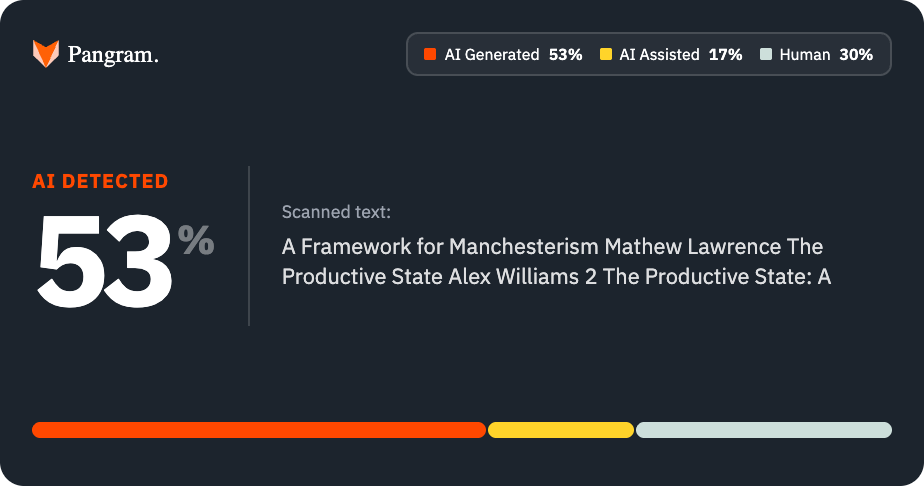
For the moment, you can build the case against AI writing purely on aesthetic grounds: the text LLMs produce tends to be turgid and bad. There was a reason I reached for Pangram as I plodded through sentences like these in “The Productive State”:
“The evidence is clear: when Britain built essential infrastructure at speed, scale and cost-effectiveness, the institutions were public. Where regulated asset bases have attracted private investment in Britain, they have done so at a financing premium. This is not an argument for the model, but evidence of its cost.”
Sam Kriss, whose prose is unmistakably human5, put the experience of “reading AI” well in the New York Times:
“All of this contributes to the very particular tone of A.I.-generated text, always slightly wide-eyed, overeager, insipid but also on the verge of some kind of hysteria.”
Still, I’ve been burned by AI exponentials enough times to be sceptical that AI writing will stay bad forever, at least for anything shorter than a book. I could be wrong, in which case my financially questionable decision to write for a living may look wise in retrospect once all my lawyer friends have gone the way of the handloom weavers. Certainly, good literary or journalistic writing is much harder to verifiably train on than something like code6, where AI is already superhuman. But I doubt it’s impossible to get there.
As an aside, that same logic actually leaves me optimistic that AI detectors like Pangram will keep up. There is an arms race, and AI obfuscators (which disguise text so it passes as human without seriously changing its meaning) are getting good too. But AI detection is a quintessential yes/no verifiability problem where you can straightforwardly create synthetic data—exactly the sort of domain where machine learning tools tend to be excellent, spotting subtle imprints a human could not.
So let me make a stronger claim: we should shun AI writing even if it is perfectly bearable to read. Why? First, its very cheapness to produce misleads readers. Writing is an act of imposition, hopefully willing, on a reader. The world contains far more text than any person can ever read. If someone has chosen your writing, you are implicitly promising them that you have something to say, and that you care enough about your point to make it well. Regardless of AI, writers ought to be generous to their readers: not taking any longer than they need to pass along their ideas7, cleaning up grammar and structure, and perhaps even jollying things up with humour—though there we must all know our limits.
AI writing decouples that signal. With AI, text can be long, superficially cogent, come with perfect spelling and grammar, but be ultimately empty of ideas and incoherent. (Most) humans struggle to sustain page after page of meaninglessness8; LLMs seem to almost prefer it that way. Fooling your readers like that does violence to their finite time and attention. And even when an AI-written article has something to say and makes its point well, there is something awful about feeling constantly on guard as a reader, never quite able to trust that the text might not suddenly revert to garble.
Obviously, sometimes this doesn’t apply. I have an AI agent that scans over economic data releases and digs through the data before emailing me a report with its findings. That’s great, but largely since you know what you’re getting. The prose—with apologies to sellside macro friends—isn’t really the point.
But most public writing is not about whether airfares distorted monthly CPI. Rather, the goal is to pull in audiences and persuade them. Palming that job off to an AI model is bad enough for professional writers. There, though, it’s ultimately only a writer’s own reputation they endanger. I’d venture that behaviour is worse still for people in public office, who have a basic democratic obligation to explain themselves to voters. Lately, some seem to be neglecting that duty.
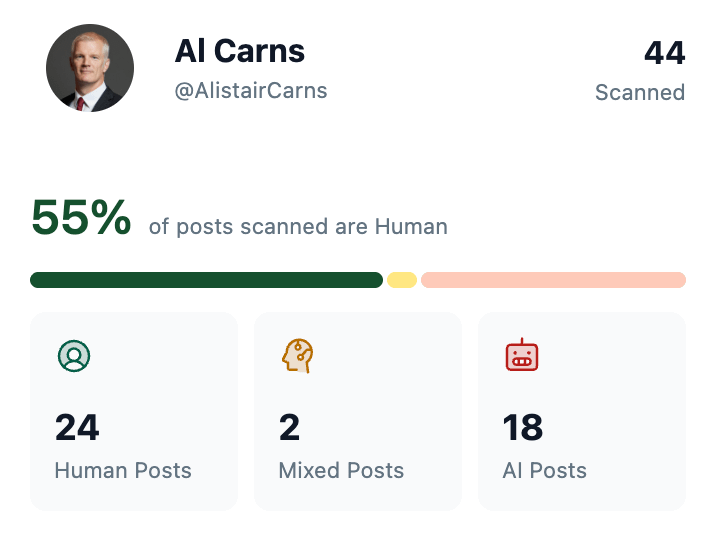
Take Al “AI” Carns, Labour MP and, until recently, armed forces minister. Pangram reckons, and my AI nose agrees, that about half his social media posts are AI-written. That includes news-making ones, like explaining the “five tests” he’d apply when deciding whether he’d support a prospective Labour leader.
You might argue that this is no different to having a speechwriter or a social media manager. Joe Biden was hardly running his own Twitter account. Perhaps that is fair, and maybe Carns sketches out his ideas in detail before handing them to a chatbot for a final polish. But I do think there is a difference between doing so with a human speechwriter, with whom you have a relationship, who you’ve chosen because they deeply understand your ideas, and with an LLM. Of course, part of the problem is also the unknowability. Did Carns do that, or did he just type “write me five tests” into Claude Sonnet 4.6 on medium thinking effort and see what it spat out?
Then the next issue: not doing the writing yourself makes your ideas worse. I chose to write about this topic partly because I know how well writing firms up your thinking. It’s hard to know how defensible your ideas are until you put them down in words. As you think things through, it’s easy to smooth over the creases. Writing forces you to confront them and push towards something that feels coherent.
One confession, for instance: I think the weakest bit of this post is a few paragraphs up, on the perils of AI writing for politicians. I may be extrapolating too much from my work to theirs. It would be pretty scandalous at The Economist if I had surreptitiously hired a 23-year-old PPE graduate to write all my articles for me, whereas that is an accepted part of what politicians do when they work with speechwriters or have aides draft their op-eds. I do think AI is different, and interacts especially poorly with the democratic obligations MPs have to explain themselves to voters. Still, writing this piece also made clear to me that this particular strand of the argument was more fragile than my initial instincts implied.
So AI lets you get away with bad thinking in a way that human writing does not. There is a third issue, too. LLMs are, still, consensus machines, and will probably remain so even if the workmanship of their prose improves. Writers, I would argue, have an obligation to novelty. Sure, sometimes, there is a drum to be banged; repetition and message discipline are part of persuasion. I will happily rant about Britain’s need for more air conditioning at any possible opportunity.
But as a writer, the question you must be able to answer is “what new am I adding in writing this?” That guides you to what’s distinctive about your thoughts and thus where to direct readers’ attention. The gravitational force of LLMs, especially in a domain as non-verifiable as contributing to the public conversation, pulls against originality. That makes them phenomenal for sense-checking ideas or getting up to speed on a topic, but awful at saying something truly interesting9.
Let me pause here for a moment. I want to end this piece by proposing some first-draft norms around AI writing. But first I thought it was worth mulling how I might be getting this wrong10. I can see two ways that my thinking here could be misguided and wanted to walk through both in turn.
Maybe I’m simply not thinking big, or long-term, enough. Prior transformative technologies have reshaped entire production processes around themselves. Quintessentially, the assembly line is unthinkable without electricity, but it also took decades for steam-age factories to be rethought from first principles to get there.
What might something similar for writing look like? Perhaps the answer is that, as AI prose gets readable and customisable, we all learn about the world through infinitely nested AI summaries. When you have an idea, the thing to do is not to write an article explaining it, but to explain it to an LLM, which writes something, which then gets digested by other people’s summary LLMs and repackaged for them. And all those personal agents are hoovering up dozens, if not thousands, of facts and ideas and effortlessly plucking out whatever’s distinctive. In that world, all you’d ever be trying to do is inject some notion into other readers’ AI models. The atomic unit of the article becomes almost meaningless.
I actually think that world’s very interesting, and wouldn’t be shocked if parts of empirical academia converge to something like that over the next few decades: clusters of mutually-referential and self-updating papers11. But we’re a long way off that today, as are the context windows, synthesis skills and writing chops of today’s AI. So let me hold onto the option to revise my views if we ever do get there. But I suspect that even then, I’ll still often want the thinking of a writer I trust who’s chewed through a topic themselves.
Or maybe, and this would be a touch off-brand, I don’t have enough faith in markets. If AI writing really is worse in all the ways I describe, won’t it just do less well and be ignored? And, countervailingly, isn’t the success of many blogs full of obvious AI text—or even of Al Carns’ tweets, which plenty of otherwise sensible people have praised as insightful—proof that I’m being a bit of a grouch?
Part of the story is exposure. People who spend a lot of time talking to AI models tend to have a better sense of their output, and correspondingly find it more off-putting when encountering AI tics in the wild12. By contributing to this conversation, hopefully I play my small part in hurrying along norms that ought to develop over time anyway.
The other answer here is that we may, sometimes, just need to be a little culturally snobbish. Do I wish the London Review of Books had the same cultural reach as the latest Romantasy hit? Of course. But the way to get there is surely not by sneaking sexy fairies into the LRB. Similarly, the world of policy and ideas needs to have inbuilt norms and defences against purely chasing the lowest common denominator, and bear in mind the ultimate goal of better ideas. I’d propose extending that notion to stigmatising most AI writing.
So what, then, should our norms around AI writing look like?13 I’ll start with the easy one, which is disclosure. Even if you disagree with almost everything else I’ve written here, hopefully we can agree that writers should say if they’re publishing AI-written or AI-assisted text, just like we’d expect authors to acknowledge their research assistants, or celebrities to recognise their ghostwriters. (That, I’m aware, isn’t always done, or at least not prominently enough. That, too, is a bad thing.)
Then we get to the harder territory. AI, used well, can clearly sometimes play a helpful role in the writing process: proofreading, research, red-teaming ideas and so on. Refusing to use a tool that obviously beats spell-checkers and search engines would be foolish, even if it is still far from a substitute for reading original sources or speaking to people.
More of an edge case is where someone has great ideas, but for whatever reason—perhaps English isn’t their first language, perhaps they just phrase their thoughts clunkily—doesn’t write well. If AI can polish their prose and help smart people reach a wider audience, surely that’s a good thing? Largely, I think it is. The answer, I suspect, is disclosure. Again, just as you might credit a translator or colleague in the comms department, you should nod to the fact that you’ve used an AI model.
But there is also a line worth holding. An easy rhetorical move that pro-AI writing types make is to jump straight from the sympathetic case I just discussed to saying that, therefore, no-one should face any stigma for pumping out AI-generated text under their own name. After all, their ideas were probably somewhere in the chatbot prompt. I think that’s wrong too. We should be able to recognise the difference between understandable and disclosed AI polish (as a second-best option to writing something yourself) and what most purveyors of AI prose are doing: outsourcing their thinking without admitting it and wasting their readers’ time.
Those thoughts are, necessarily, only a first draft. Getting social standards right is hard and inevitably there will never be full agreement. Even something like plagiarism, which has been around for as long as there’s been writing, has fights over edge cases—recall the allegations about Harvard’s former president Claudine Gay a few years ago. There was lots of bad faith then, but also reasonable people disagreeing. All that is an argument to take time, think things through, and hash them out. Certainly, it is no reason to surrender to the slop.
Appendix: Can we trust the AI detectors? A worked example
The very notion that you can stigmatise AI writing relies, of course, on being able to credibly show when text has been produced by AI. Plenty of the AI detectors that emerged a few years ago were dodgy and easily fooled. But I don’t think many people have fully internalised that Pangram, the current market leader, is quite good.
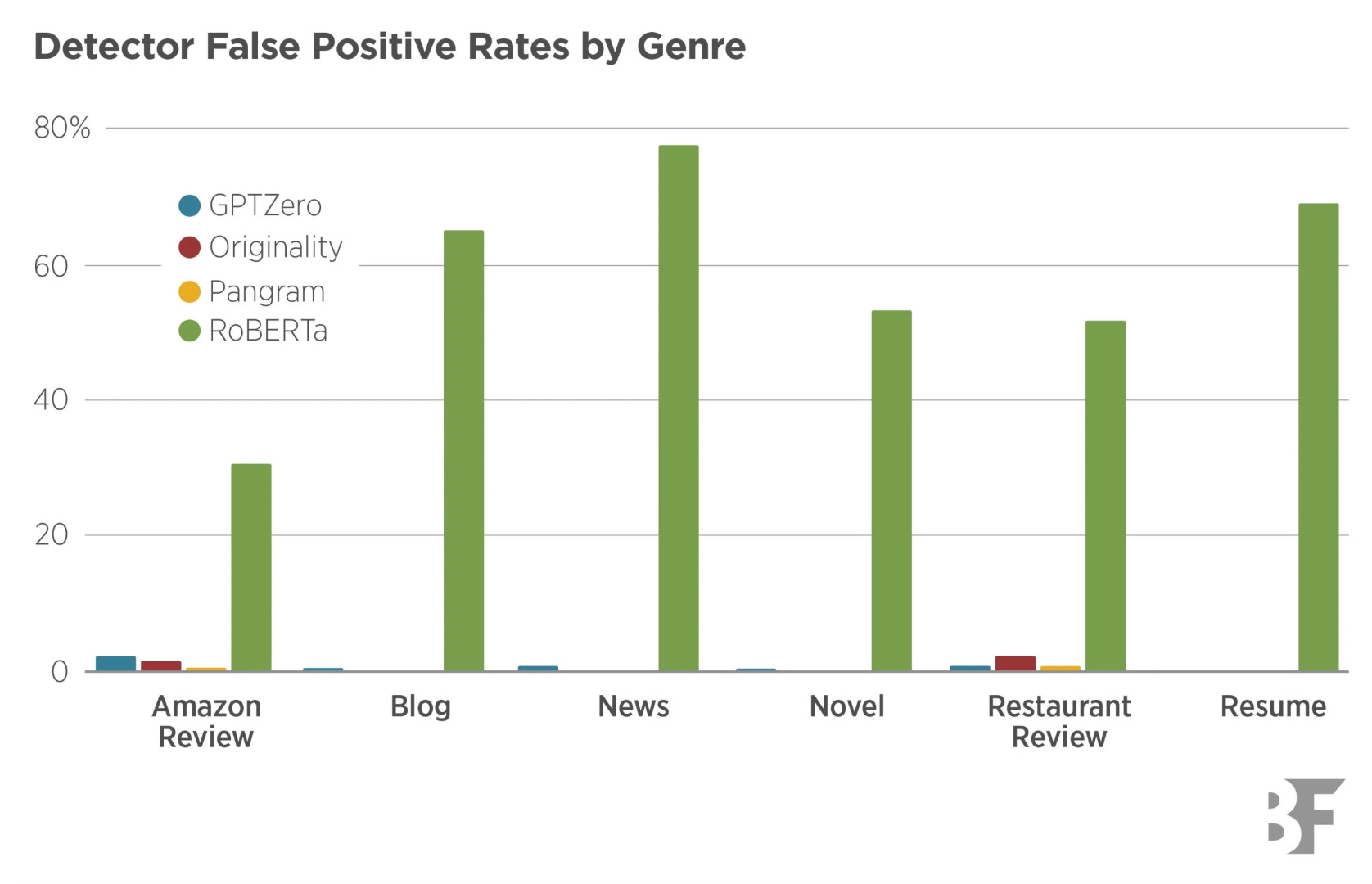
Academics from the University of Chicago found a vanishingly low false positive rate in a study last year, as you can see in the chart below. Pangram says it aims for 1 in 10,000. That certainly isn’t quite a consensus view: the Wall Street Journal’s op-ed editor called it a “defamation machine”. But my reading of the evidence, and tests I’ve run myself, leaves me pretty happy saying that if Pangram flags something as AI-generated, your strong prior should be that it is. I found this recent interview with Pangram’s CEO, Max Spero, to be helpful in understanding how the technology works.
That is the state of play now, but it may change. Ideally, we’d have ongoing evaluations of detectors to see if new models are getting round them.
One critique that doesn’t hold water is that certain sorts of robotic-feeling writing, like think tank reports, inherently trip up AI detection tools. That was the defence offered by people sympathetic to the authors of “The Productive State” when I quite loudly pointed out it was almost certainly heavily AI-written.

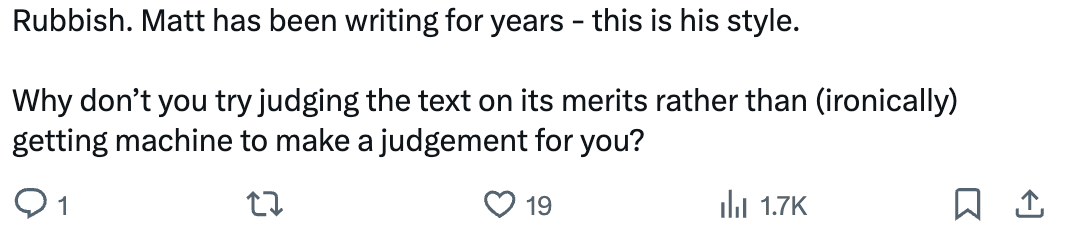
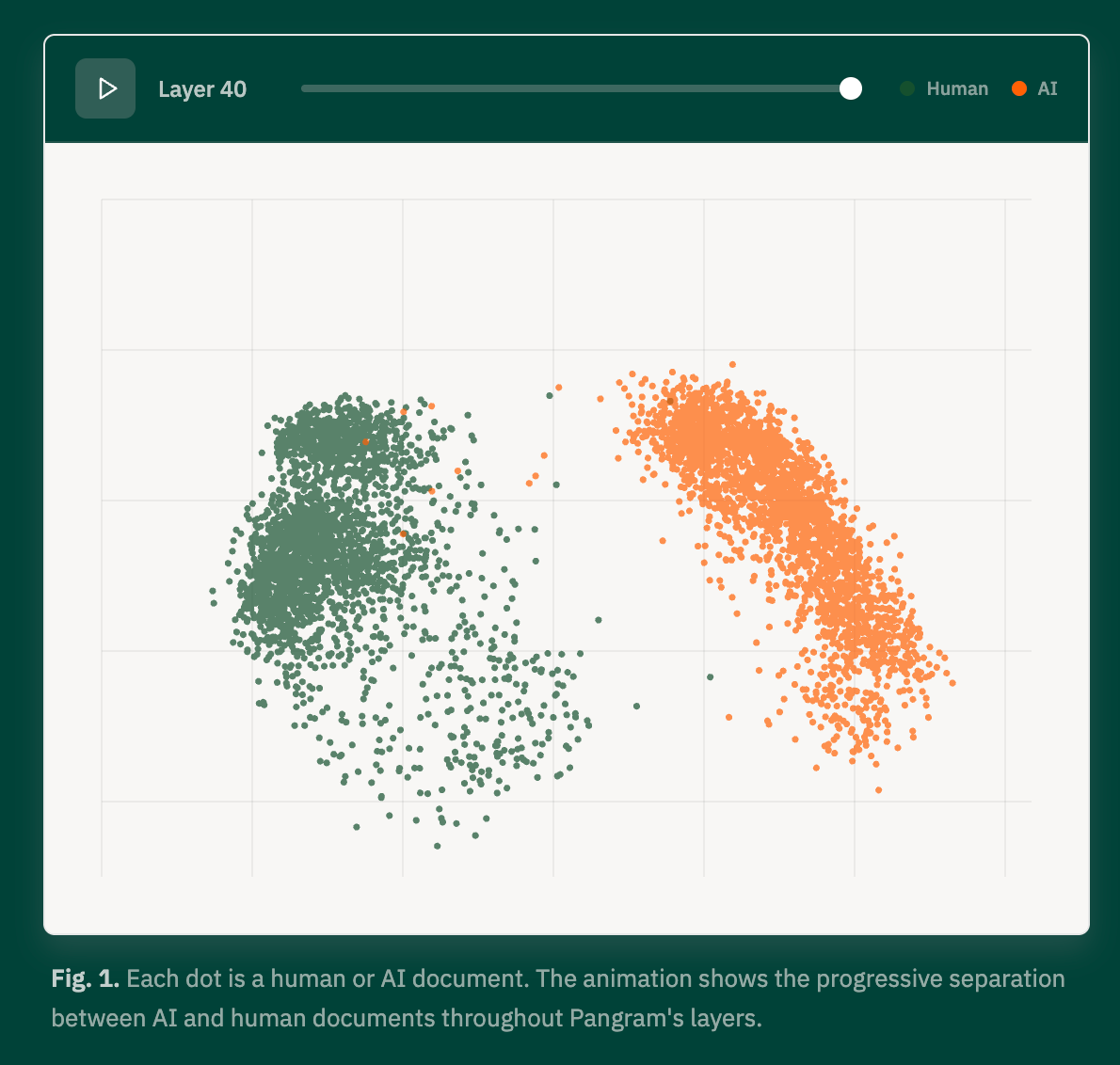
I always sympathise with people who stand up for their friends (EM Forster and all that). But this betrays a total misunderstanding of how tools like Pangram work. What it is not doing is mechanically counting em-dashes, tricolons and other classic markers of AI prose. Rather (and this explainer on its website is helpful), it uses black-box machine learning, picking up on a faint AI fingerprint that you couldn’t catch with formulaic rules alone. In a sense, that is not too far off what humans do, too—think of the slightly-off feeling you get when you sense you’re reading AI text but can’t immediately say why. The image below illustrates their process.
Helpfully, though, there is also a simple empirical test for the claim that AI detectors are just picking up on the writerly tics of policy wonks rather than actual AI use: looking at pre-LLM output. If Pangram is mistakenly labelling wonk-speak as AI, that should also apply to work done before 2022, when ChatGPT hadn’t been released but think-tankers were still writing obtuse prose.
So I fed every publication from Common Wealth, the think tank behind “The Productive State”, into Pangram and took a look at what got flagged as AI. About $70 in API calls later (more than one should probably spend litigating a Twitter spat), I got the results below. Not a single report from before late 2025 was flagged as AI. Since then, four have been, though none as decisively as “The Productive State”14.
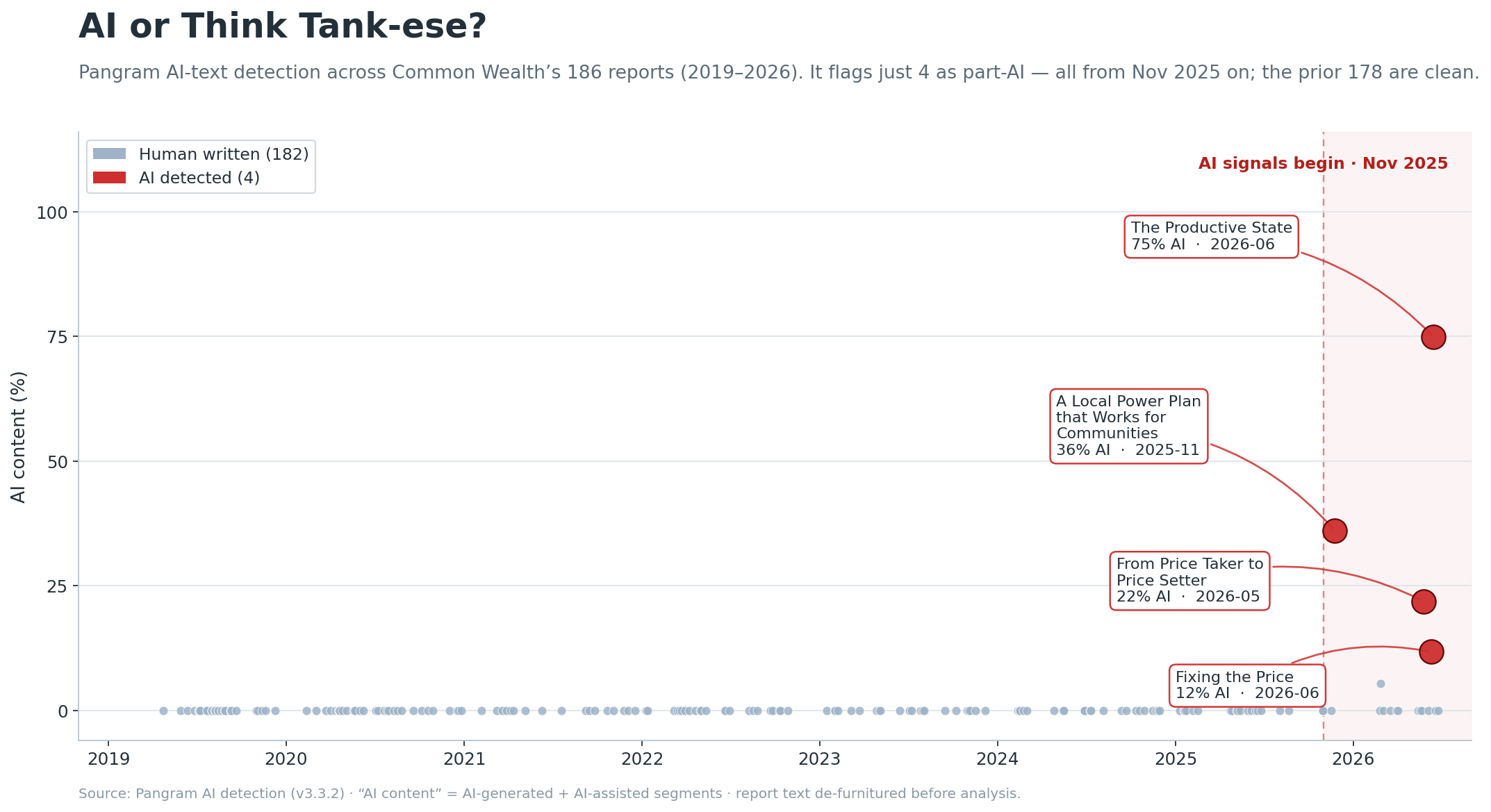
That hopefully closes the case in both directions: “The Productive State” was almost certainly largely AI-written, but Common Wealth is also usually not a slop factory, though some AI has been creeping into their more recent interventions.
I should also add that I do substantively disagree with Common Wealth on lots, but that really isn’t why I picked up on this so forcefully. I think there’s a basic point of epistemic hygiene, especially for people trying to sell the country on their favoured policies, that precedes the actual ideas in question.
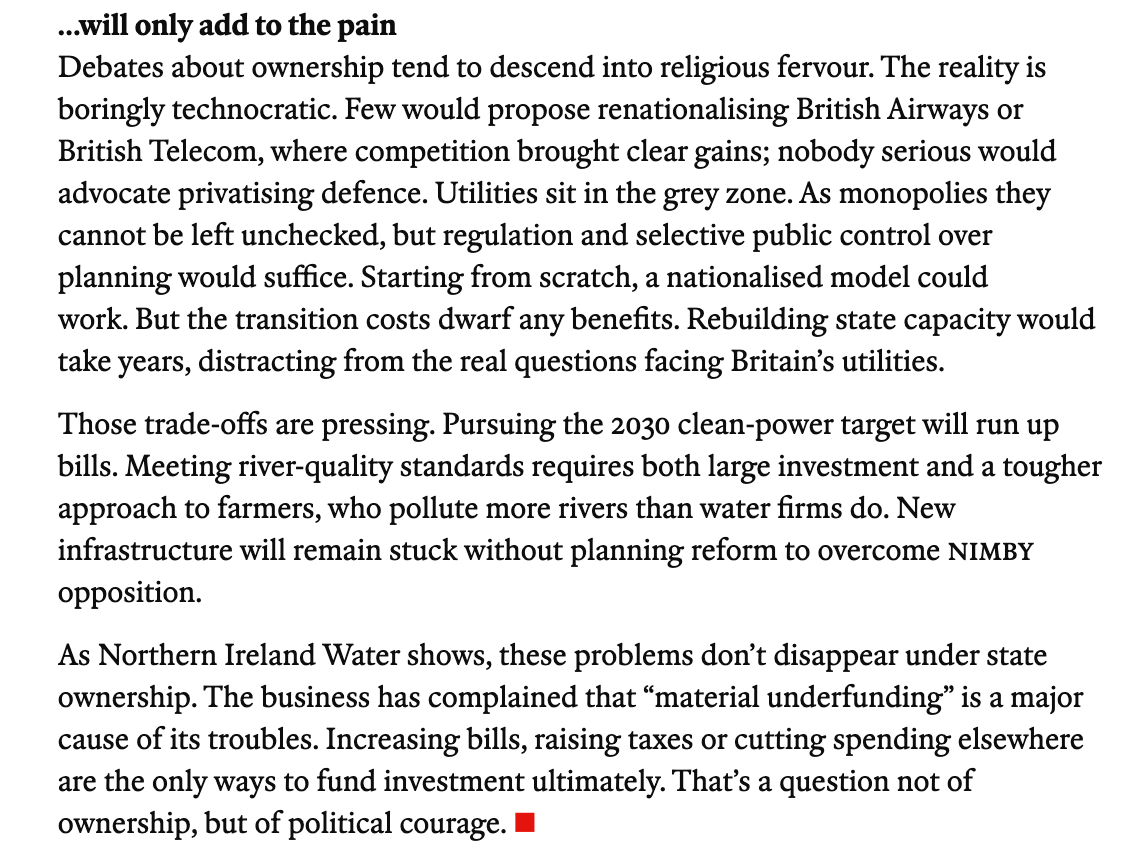
On the substance of their report, my colleague Tom Carter did a great job a few weeks ago laying out why the ownership of utilities has little to do with Britain’s economic underperformance, and hardly even helps explain the underlying problems with the utilities themselves. You can read his full piece here.
Personally, AI policing British politics has been a fun bit, but I now plan to retire it, at least outside any truly outrageous AI babble. I’ve probably given Pangram enough free PR by now, and don’t want to end up defined by just that obsession. But stay wise out there!
Incidentally, do give that cover leader a read, as well as the bevy of accompanying articles from colleagues.
I should say that I’m generally quite excited about what AI will do for jobs like mine. Automating the duller bits of data wrangling and economic analysis has been a huge lift, and given this Substack has no editor or fact-checker bar me (don’t say you weren’t warned), we should all be grateful that I generally have a couple of the latest models proofread and red-team my pieces here before they go out.
Joe Weisenthal wonders whether not using AI for writing will feel like refusing to use Google Maps to get around a city before too long. Alexander Kustov, an academic who does great work on the political science of migration policy, also thinks that “Pangram Policing is the New Grammar Nazism” and these days posts mostly AI-assisted pieces on his blog.
There’s a bit more further down on how well Pangram works but (a) there are pretty good third-party evaluations, (b) I find it robustly lines up with my own ear for AI-ese. Obviously AI obfuscation technology is also getting better, so today’s moment—where AI writing is pretty straightforward to identify, unless the author has gone to a lot of effort hiding it—may not last. But that’s where we are for now.
If frankly not always to my taste. (Which speaks well to his distinctiveness.)
Jasmine Sun wrote a great piece for The Atlantic on this question.
Unless luxuriating in a writer’s distinctive voice is itself the goal.
I read enough French social theorists at university to be wary about making this proclamation too universal.
In contexts where you have reinforcement learning on extensive self-play, like Go, computers clearly can be “creative” in some way. But open-ended thinking is close to the opposite of that sort of task.
There is a certain irony in the fact that this is probably the point in the chain-of-thought where an LLM would also double back and check what it was missing.
Andy Hall at Stanford has some cool thoughts on these themes.
As it happens, in a way that I think the brouhaha over the AI-assisted Common Wealth policy paper revealed, communities—like chunks of the left—that are wary of AI are also more naive to it, and more easily taken in by AI outputs.
Obligatory (silly) reminder that these are some loose thoughts about broad societal norms. Obviously The Economist has a hard policy against AI writing and, equally consequentially, so does my Substack.
Eagle-eyed readers may notice that this check got 75% AI for “The Productive State” versus 70% for my earlier check. That, I think, is mainly down to me doing a better job of removing “furniture” (page numbers, PDF formatting and so on) this time around.
When the purpose of your writing is to showcase your thoughts, using AI at any stage of it (including the research stage) seems a dereliction of duty, precisely because people are expecting to hear what you think, not a machine.
I think it's intellectually dishonest to only be concerned about AI writing, but nothing about AI cheapening creative work in general, while at the same time claiming that it will magically lead to economic growth and advances in every field.
All your reasons to be against AI writing are equally applicable to any chatbot/LLM output, whether it's for business or creative writing - after all it's all tokens under the hood.
Disclaimer: when I say "AI" I'm referring specifically to LLM/genAI chatbots, which is the current popular meaning of the term imo